Utah Wild Clay: How to Find and Test Local Clay
Utah wild clay is everywhere — but most people never notice it.
Once you start working with clay, the landscape changes. Road cuts look different. Dry creek beds feel different. Even construction sites become interesting. You start asking a new question: Is there usable clay here?
Wild clay simply means clay that hasn’t been commercially processed. It’s taken directly from the earth in its natural state. Unlike bagged clay from a supplier, wild clay contains everything that formed with it — sand, iron, soluble minerals, organic material, and unpredictable particle sizes.
That unpredictability is both the challenge and the draw.
Why Utah Is Interesting for Wild Clay
Utah has a complex geological history. Much of northern Utah, including Cache Valley, sits on ancient lake beds from Lake Bonneville. That history influences mineral content, shrinkage rates, and iron levels in local soils.
Some Utah wild clay is extremely high in iron. Some contains soluble salts. Some is short and sandy. Some is surprisingly plastic.
There is no single “Utah clay.” Every deposit is different.
That’s why testing matters.
How to Find Wild Clay in Utah
If you’re searching for wild clay in Utah, look for:
Exposed soil in dry creek beds
Fresh road cuts where subsoil is visible
Construction sites (with permission)
Fine-grained earth that cracks when dry
Areas where water has naturally eroded topsoil
A simple field test:
Wet a small handful and try to roll it into a coil. If it holds together without immediately cracking, it may contain usable clay.
Always collect responsibly. Take small samples. Avoid protected land. Respect private property.
Wild clay research should be sustainable and minimal-impact.
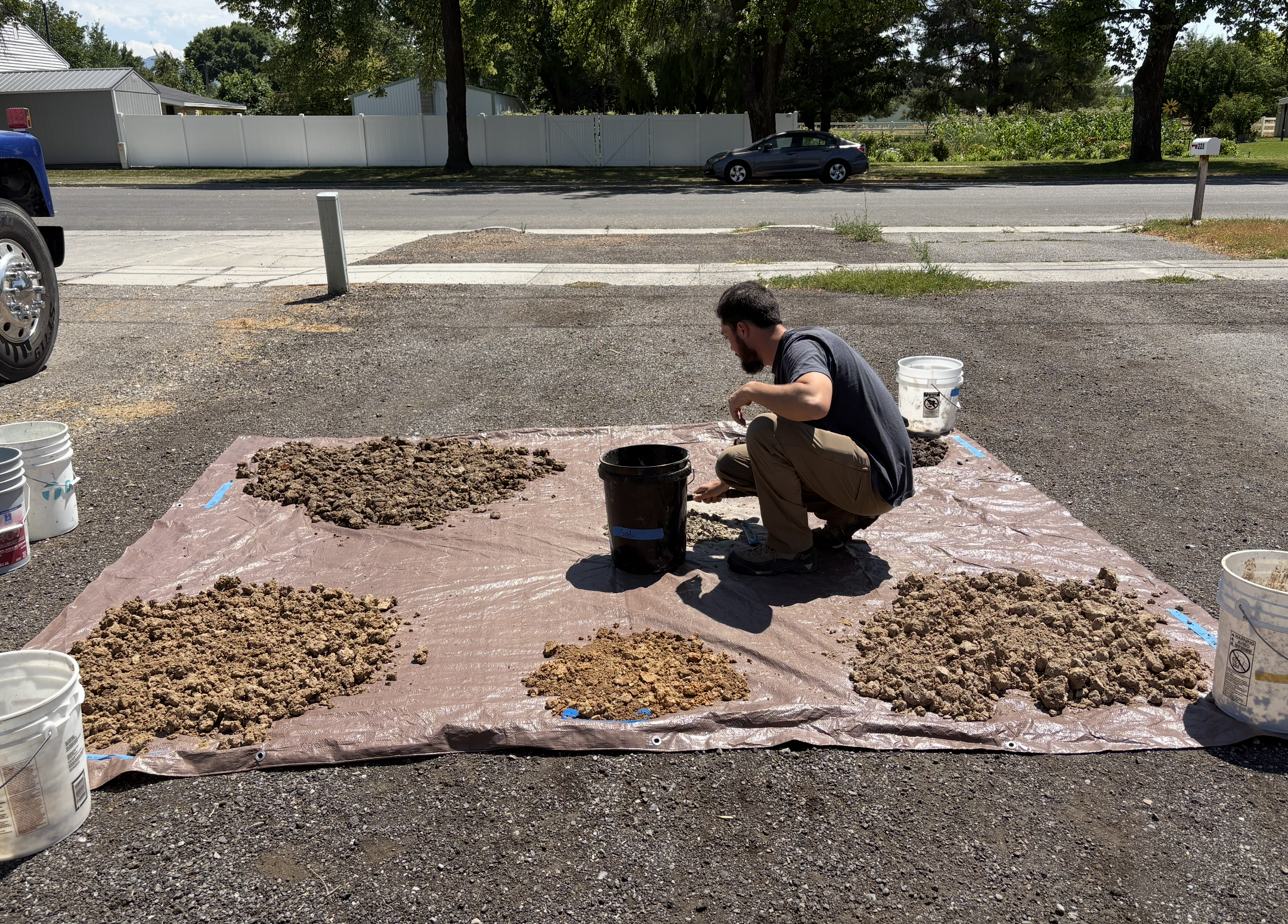
How I Process Utah Wild Clay
Once I bring home a small sample, the real work begins.
Drying – I let the clay dry completely.
Crushing – I break it down into smaller chunks.
Slaking – I add water and allow it to dissolve into slurry.
Sieving – I run it through progressively finer screens to remove rocks and debris.
Settling & Drying – I let the clay settle, pour off excess water, and dry it to workable consistency.
At that point, it looks more like traditional clay — but it’s still unknown.
Testing Utah Wild Clay
Testing is everything.
I make small test tiles and fire them at different temperatures — usually mid-range and high-fire. I record:
Shrinkage from wet to bone dry
Shrinkage after firing
Warping or cracking
Absorption rate
Surface texture
Color changes
Many Utah wild clay samples crack heavily during drying. Some bloat or melt in high-fire conditions. Others remain underfired and porous even at cone 10.
Every now and then, one responds beautifully.
Deep iron reds. Warm browns. Subtle speckling. Surfaces that feel directly connected to the hillside they came from.
Those are the samples worth pursuing.
Can You Make Pottery from Utah Wild Clay?
Sometimes yes. Often no — at least not without modification.
Many wild clays benefit from blending with a more stable commercial clay body. Some work better as slips or glaze materials rather than full clay bodies. Some need grog or sand added to reduce shrinkage.
Wild clay is rarely plug-and-play.
But when it works, it carries something commercial clay can’t: a literal connection to place.
Why Work with Wild Clay at All?
Using Utah wild clay slows the process down. It forces you to understand material at a deeper level. It builds awareness of geology, mineral content, and firing behavior.
For me, wild clay research is part of building a studio practice rooted in northern Utah. If I’m firing in a salt kiln and committing to atmospheric processes, it makes sense to explore the soil those pots come from.
This is still research. I’m not claiming mastery. I’m documenting experiments — failures included.
But if you’re interested in wild clay Utah conversations, testing local deposits, or understanding how natural clay behaves in high-fire conditions, this is where that exploration begins.
There’s a lot more to learn.
— Adam
