Not Everything Belongs in My Kiln
I don’t fire everything I make.
That surprises people sometimes. There’s an assumption that once a pot is formed, trimmed, and dried, it deserves to be finished. That time invested automatically earns it a glaze and a spot in the kiln.
It doesn’t.
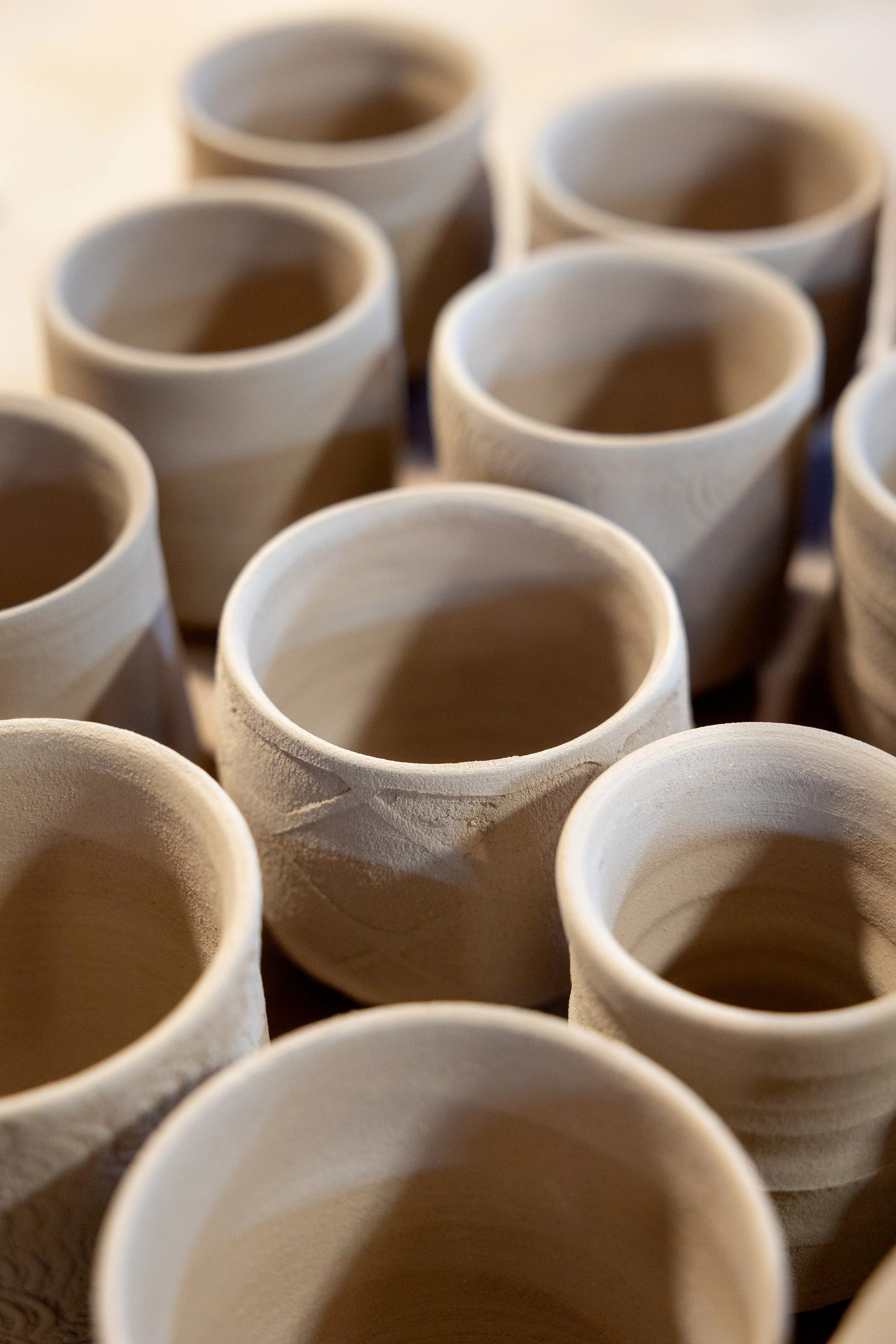
Some pieces stop on the ware board.
In functional work — mugs, bowls, vases — restraint matters more than variety. It’s easy to experiment endlessly. New handles. Altered rims. Decorative additions. Surfaces that shout for attention. Social media rewards novelty. Markets reward color.
But that isn’t what I’m building.
If a mug feels slightly off balance when I lift it, it doesn’t go forward. If the rim is a fraction too thick. If the foot ring doesn’t sit clean and quiet on a flat surface. If the handle pulls the form sideways instead of supporting it. It doesn’t matter how interesting the glaze might look later.
It stops there.
There’s a kind of discipline in functional pottery that doesn’t get talked about much. Editing. Cutting back. Refusing to decorate your way out of a structural weakness.
A strong surface can hide a weak form — at least visually. Especially at high fire, especially as I move deeper into salt fired pottery. Flame and vapor create variation that feels alive. It’s tempting to let the kiln do the heavy lifting.
But salt doesn’t fix proportion.
It doesn’t correct weight distribution. It doesn’t resolve an awkward transition between wall and base. If anything, atmospheric firing exaggerates those issues. The more honest the firing, the more exposed the form becomes.
So I refuse certain things.
I don’t chase bright color just because it’s popular. I don’t add texture to compensate for a shape that isn’t resolved. I don’t keep pieces that technically “worked” but feel unsettled in the hand.
There’s a line in the studio. It’s quiet, but it’s firm.
Sometimes that means reclaiming clay at the leather-hard stage. Sometimes it means smashing a bisque piece that survived the first firing but didn’t earn the second. That part doesn’t feel dramatic anymore. It feels necessary.
When you work at cone 10, the clay matures fully. There’s no hiding behind softness. The structure is either right or it isn’t. The heat clarifies everything.
That’s one reason I’m drawn to high fire. It forces honesty.
The goal isn’t perfection. Handmade work should still feel human. A slight variation in thickness. A subtle shift in flame. Those are part of the language. But sloppiness is different from variation. Carelessness is different from character.
I can tell the difference.
And over time, so can the people who use the work.
Not everything belongs in my kiln because not everything meets the standard. The kiln isn’t a finishing machine. It’s a commitment. Once something goes through a full firing cycle, especially a future salt firing, it carries my name permanently.
That matters.
The work that does make it through — the mugs that sit evenly, the bowls that feel grounded, the rims that resolve cleanly — those are the pieces I stand behind. They aren’t flashy. They aren’t loud. But they’re steady.
That’s the kind of pottery I want associated with my name.
If it doesn’t hold up, it doesn’t leave.
I don’t make everything. I don’t keep everything. And I don’t sell work I wouldn’t use myself every day. What does make it out of the kiln is meant for real kitchens and real routines — steady, durable, high fire pottery.
You can see current work and follow the studio at adamcorbridgepottery.com
Adam Corbridge
adamcorbridgepottery.com