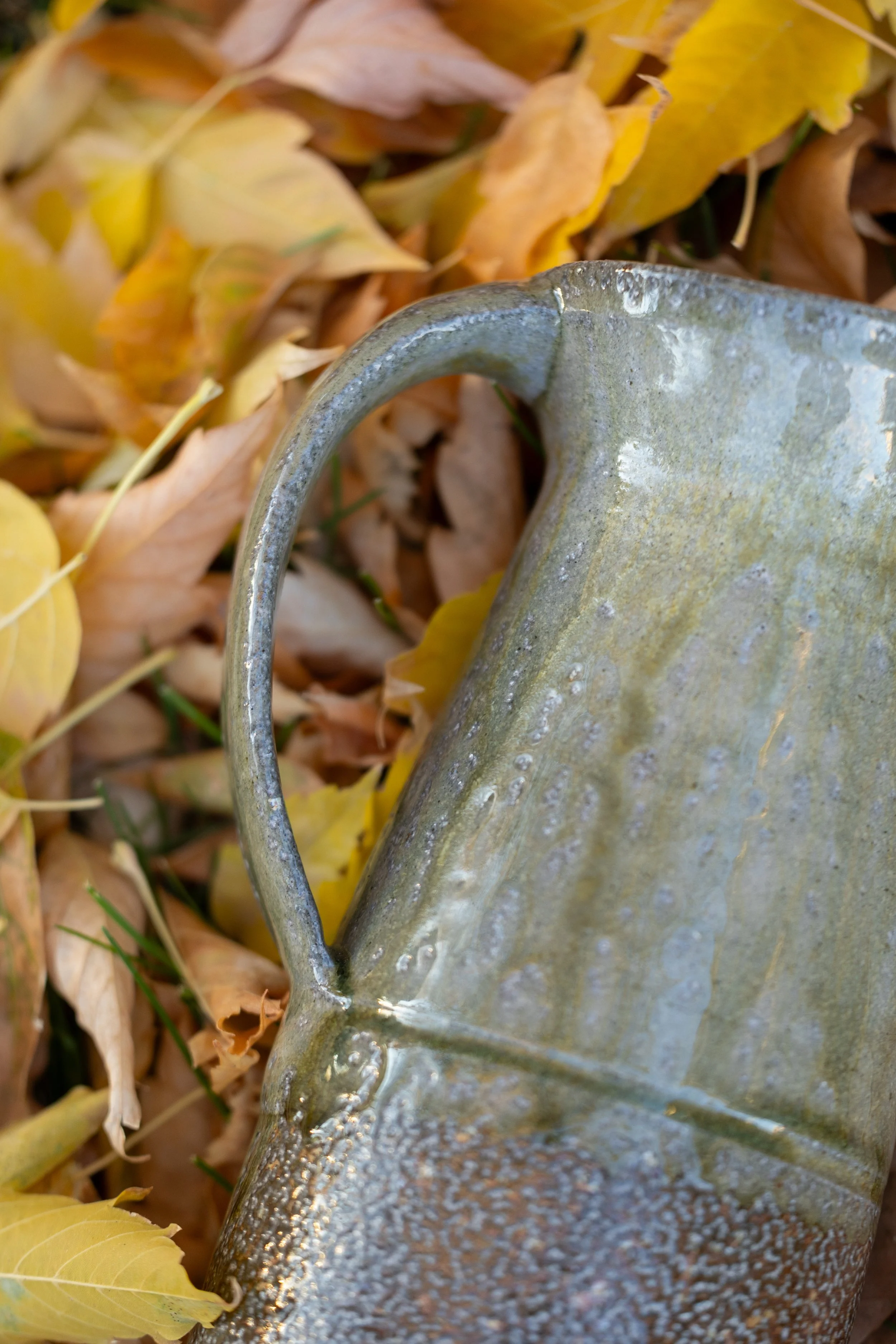
Why Some Handles Feel Right
You can tell in a second.
Slide your fingers through the handle of a mug and you know immediately whether it works. There’s no analysis. No checklist. It either settles into your grip or it doesn’t.
That response isn’t accidental.
A comfortable handle is geometry. Curve, thickness, attachment points, negative space. It’s not decoration added after the fact. It’s structure.
When I pull a handle, I’m thinking about weight before anything else. Not the weight of the clay strip in my hand — the weight of the mug once it’s full. A handle has to carry twelve to sixteen ounces of liquid without twisting in your grip. That means the top attachment point needs to align closely with the mug’s center of gravity.
If it’s too high, the mug tips awkwardly.
If it’s too low, it feels heavy at the bottom.
A few millimeters change everything.
Then there’s thickness.
Too thin and it bites into your fingers once the mug is full. Too thick and it feels clumsy. I’m not aiming for delicacy. I’m aiming for strength with refinement — enough mass to support weight, shaped so it doesn’t feel bulky.
The cross-section matters too. A perfectly round handle sounds ideal, but often a slightly oval shape feels better. It spreads pressure more comfortably across your fingers. Subtle flattening where the thumb rests gives stability without announcing itself.
None of this is obvious from across the room.
It shows up in use.
I also pay attention to the negative space — the opening itself. Two fingers? Three? There should be room without excess. If your knuckles brush the body of the mug, it feels cramped. If the opening is oversized, the mug can feel unstable because your grip floats.
The curve should mirror the form without copying it exactly. A mug with a soft belly needs a handle that supports that curve without exaggerating it. The handle shouldn’t look pasted on. It should feel inevitable.
Attachment is another quiet detail.
I compress both connection points firmly into the body. That’s structural, not cosmetic. A poorly attached handle may hold at first but can weaken over time with repeated heating and cooling. At cone 10, clay tightens and matures fully. If the joint wasn’t compressed properly at leather hard, the kiln won’t forgive it.
When trimming is done and the handle is attached, I let the mug sit for a moment before deciding it’s finished. I’ll pick it up. Feel the balance. Sometimes a handle that looked right visually needs slight adjustment before it firms up.
That’s the part most people don’t see — the pause.
A good handle disappears when you use it. It doesn’t draw attention. It doesn’t ask you to adjust your grip every time. It supports the weight quietly.
Bad handles are distracting. You feel the pressure point. You shift your fingers. You compensate without realizing it.
Over time, that’s the difference between a mug you use occasionally and the one you reach for every morning.
Comfort isn’t accidental.
That’s the standard behind every mug at adamcorbridgepottery.com.
Adam Corbridge
adamcorbridgepottery.com