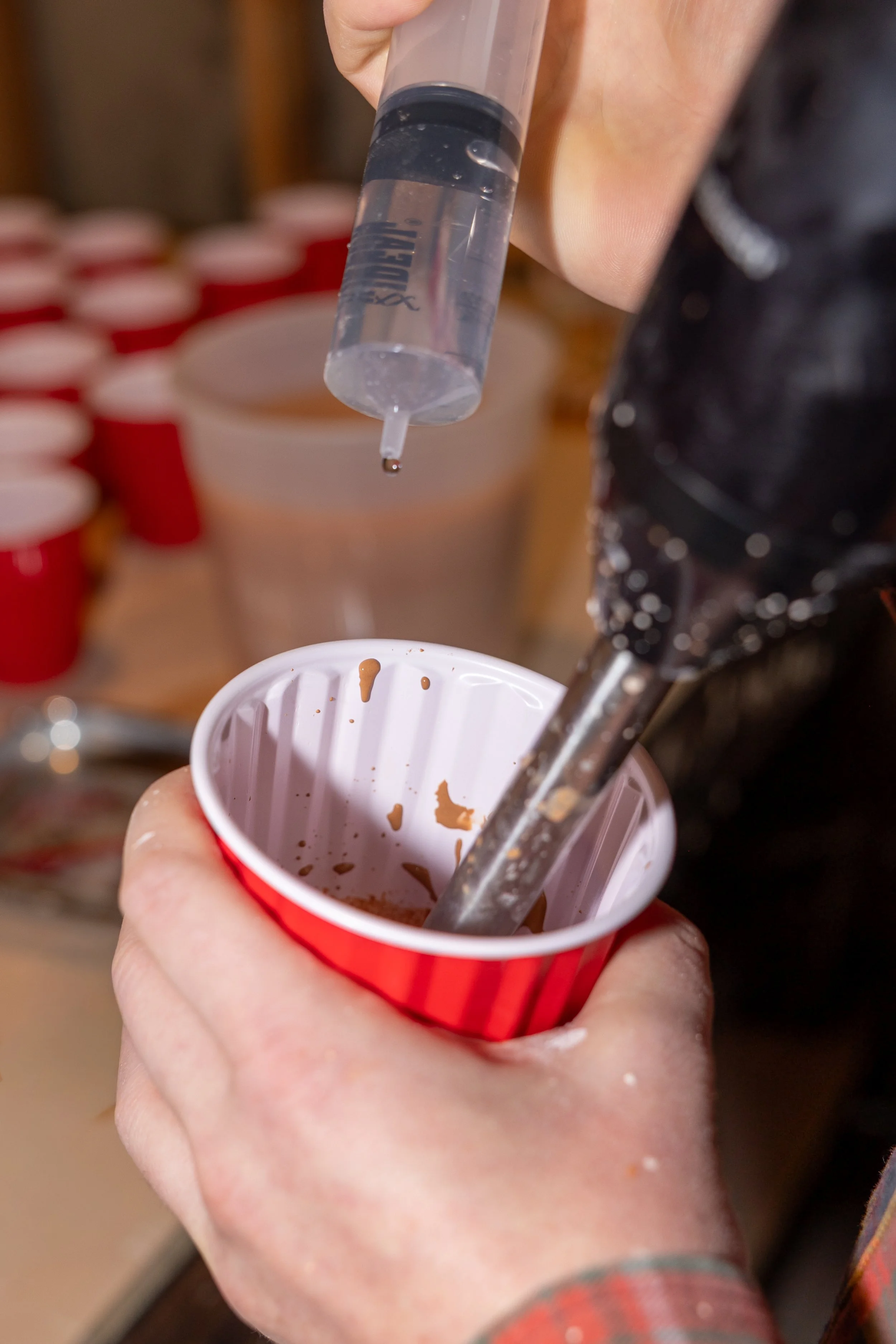
Consistency Starts With Measurement
“I dipped it a little longer.”
That’s not a system.
Glaze thickness controls more than people admit. Surface depth. Color development. Break lines. Pinholing. Crawling. Even glaze fit over time. And yet most glaze problems trace back to one simple issue: no one measured anything.
If you want repeatable results, you have to measure.
Start with specific gravity.
Specific gravity tells you how much material is suspended in the water. It’s not about how thick the glaze looks. It’s about how much solid material is actually there. Two buckets can feel similar with a stirring stick and behave completely differently in the kiln.
A simple hydrometer or scale-based calculation fixes that.
If I mix a glaze to 1.45 specific gravity and record it, I can come back months later and recreate it. If I just add water until it “feels right,” I’m guessing.
Then there’s dip time.
Saying “I dipped longer” doesn’t mean anything unless the glaze consistency is fixed. If the specific gravity is controlled, dip time becomes meaningful. One second versus three seconds changes thickness in measurable ways. Especially at cone 10, thickness shifts how iron moves, how ash settles, how edges break.
But dip time only matters if the bucket is consistent.
Viscosity is the next layer.
Two glazes at the same specific gravity can apply differently if their clay content differs. A glaze heavy in clay may feel thicker and hold more material per dip. A more fluid glaze may run even at the same gravity.
This is where sieving and proper mixing matter. Undissolved materials, settled layers at the bottom of the bucket — all of it changes how the glaze applies.
If you want replication, you need:
• Specific gravity recorded
• Dip time recorded
• Firing schedule recorded
• Clay body recorded
Without those four, you’re just hoping.
Why does this matter beyond surface aesthetics?
Because glaze thickness affects durability.
Too thin and the glaze may not fully seal the surface. Too thick and it can crawl, pinhole, or craze later because internal stresses increase. At high fire, especially cone 10, thicker glaze layers move more. Iron-rich surfaces can pool. Ash glazes can run.
If you don’t know how thick the glaze is going on, you don’t really know why a result happened.
I’ve had glazes look completely different because the bucket drifted 0.05 in specific gravity. That’s a small number. But it shifts application enough to change the surface.
Consistency doesn’t remove variation.
It controls the variables you can control.
That’s especially important as I move deeper into salt firing. When atmosphere already introduces variability, the base glaze needs to be predictable. Otherwise you’re stacking chaos on top of chaos.
Measurement isn’t about turning pottery into a laboratory.
It’s about respecting repeatability.
If a surface works — if it fits the clay body, survives cone 10, and ages well — I want to be able to make it again. Not approximately. Intentionally.
Good surfaces aren’t accidents.
They’re measured.
See the results at adamcorbridgepottery.com.
Adam Corbridge
adamcorbridgepottery.com