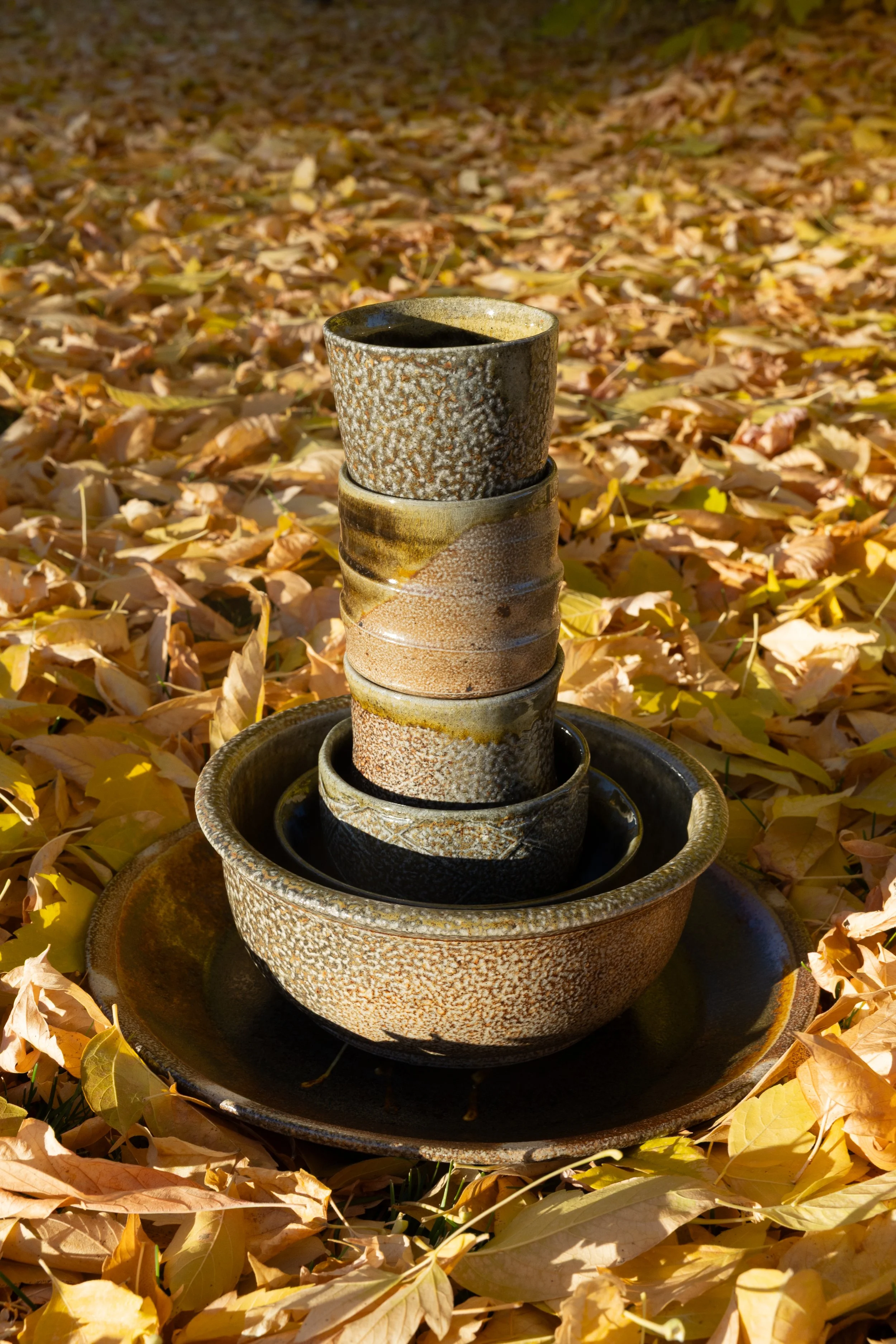
Why Salt Fired Surfaces Age Well
Some surfaces fade.
Bright colors lose intensity. Gloss softens unevenly. Trends move on and the piece that once felt bold starts to feel dated.
Salt fired surfaces don’t work that way.
At high temperature, when salt vapor moves through a kiln and reacts with the silica in the clay body, the surface that forms isn’t just decoration sitting on top. It’s integrated. Sodium bonds with the clay. The glaze isn’t applied so much as created in the atmosphere.
That changes how it ages.
Instead of a thick, glassy layer dominating the form, salt firing produces depth. Slight orange peel texture. Subtle flashing where flame and vapor met the surface differently. Soft variation rather than graphic contrast.
Over time, that restraint holds up.
When a salt fired mug is used daily, the surface doesn’t peel or flake. It doesn’t wear in patches the way some lower-fired decorative glazes can. It develops familiarity. The foot ring smooths slightly from contact with tables. The handle burnishes where fingers rest. The form settles into use without losing character.
That’s the kind of aging I’m interested in.
I don’t want pottery that peaks visually on day one and declines from there. I want work that looks better a year later because it’s been handled. Because it’s been part of someone’s routine.
Salt surfaces support that.
They’re not loud. They don’t rely on high contrast or saturated color. They rely on depth — the kind you notice in changing light. Morning light across a kitchen table. Late evening shadows. Steam rising against a muted surface.
That subtlety is durable.
As I build toward firing my own salt kiln, this is part of what draws me to it. Not nostalgia. Not novelty. Longevity. Salt firing has been around for centuries because it produces surfaces that hold up — physically and visually.
It pairs well with cone 10 maturity. The clay body is fully vitrified. The surface is bonded at high heat. The result isn’t fragile or decorative for the sake of decoration. It’s functional, with depth.
That’s what I want associated with my work.
I’m not chasing dramatic texture. I’m not trying to create spectacle. I’m after surfaces that feel grounded — that age without looking tired.
A good salt fired piece doesn’t demand attention every time you see it. It earns familiarity instead.
I’m building toward salt for a reason.
You can follow the work — and find available pieces — at adamcorbridgepottery.com.
Adam Corbridge
adamcorbridgepottery.com