What Changes Between Throwing and Trimming
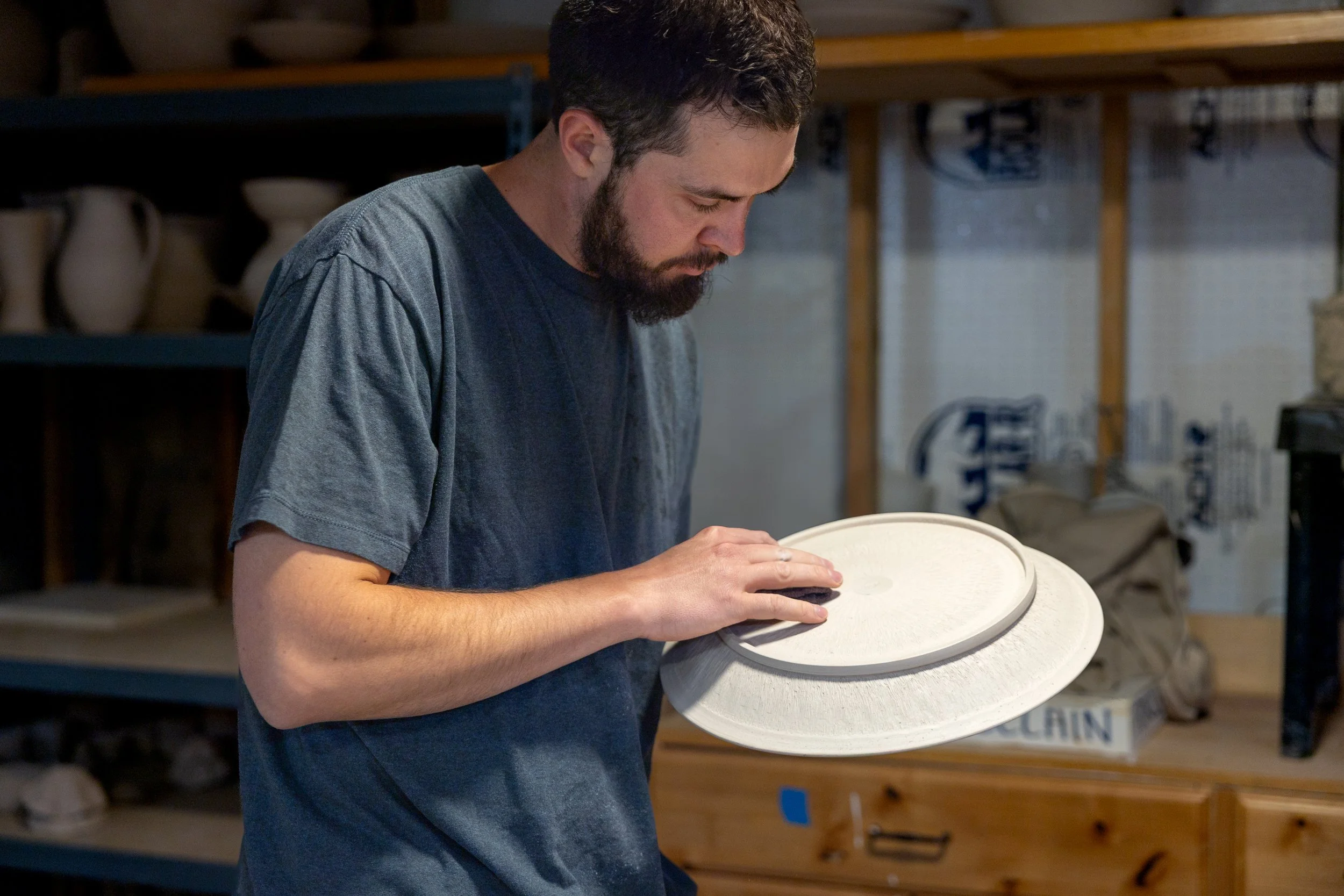
Throwing gets the credit.
It’s the visible part. The wheel spinning. The walls rising. Clay moving under steady hands. If someone walks into the studio while I’m working, that’s the moment they usually stop and watch.
But the form isn’t decided there.
When I wire a mug off the wheel and set it on the board, it looks finished. The curve is set. The rim is compressed. The handle might already be pulled and resting nearby. To most people, that’s the pot.
To me, it’s still unresolved.
Clay changes as it firms up. What feels balanced when it’s soft can feel heavy twelve hours later. A base that looked proportional at full plasticity can look swollen once the surface tightens to leather hard.
That’s why trimming isn’t cleanup. It’s adjustment.
When I flip a mug over onto the wheel for trimming, the first thing I’m checking is weight. Not the number on a scale — the distribution. Where is the mass sitting? Does the lower third feel dense compared to the upper wall? Did I leave too much clay in the floor?
High fire pottery exaggerates these decisions. At cone 10, the clay body vitrifies fully. It tightens and settles. If the base is too thick, it stays visually heavy even after firing. If the foot ring is too shallow, the piece can feel grounded in the wrong way — stuck instead of stable.
So I cut deliberately.
The trimming tool isn’t there to make the pot lighter at any cost. It’s there to create lift. A defined foot ring introduces shadow. It gives the form a place to end. It separates the pot from the table just enough.
Too much trimming and the piece feels fragile. Too little and it feels unresolved.
This is where small decisions compound.
I’ll often remove clay from just inside the foot ring to reduce mass without thinning the outer edge. That keeps durability where it matters while correcting weight. I might sharpen the transition between wall and base if it softened too much during throwing. I’ll check that the base is flat — not visually, but mechanically. A slight rock after firing is unacceptable in functional work.
The rim gets checked again too. Even if I was careful while throwing, leather hard clay tells the truth. If there’s uneven thickness, I can see it in the way the wall dries. Sometimes I’ll lightly refine the top edge with a sponge, not to reshape it, but to confirm consistency.
What changes between throwing and trimming isn’t the design.
It’s the clarity.
Throwing is fluid. Trimming is analytical. At the wheel, you’re responding in motion. During trimming, you’re evaluating. You’re asking whether the original decisions hold up.
Some don’t.
I’ve trimmed mugs that looked strong on day one but felt bottom-heavy once firmed up. I’ve adjusted bowls that seemed open and generous when soft but felt tight once they stiffened.
That’s the work most people never see.
In functional pottery — the kind meant for daily use — balance isn’t decorative. It’s physical. A mug that’s too heavy at the base changes how it feels when full. A bowl with excess clay in the foot feels clumsy when lifted from the table.
Trimming is where I remove what isn’t necessary.
It’s editing in three dimensions.
And sometimes it’s restraint. If a piece already feels resolved, I don’t overwork it just to leave a more dramatic foot. There’s a temptation to carve deeper, to show evidence of effort. I don’t. The goal isn’t to display trimming marks. It’s to refine proportion.
By the time a piece leaves the trimming wheel, it should feel lighter without being thin. Grounded without being stuck. Quiet without being plain.
Throwing starts the form.
Trimming decides whether it was worth keeping.
Refinement happens later.
If you’re interested in work that’s shaped just as much by restraint as by movement, you can see what’s currently available at adamcorbridgepottery.com. I release small batches of functional pottery built for daily use — balanced, durable, and meant to last.
Adam Corbridge
adamcorbridgepottery.com
